




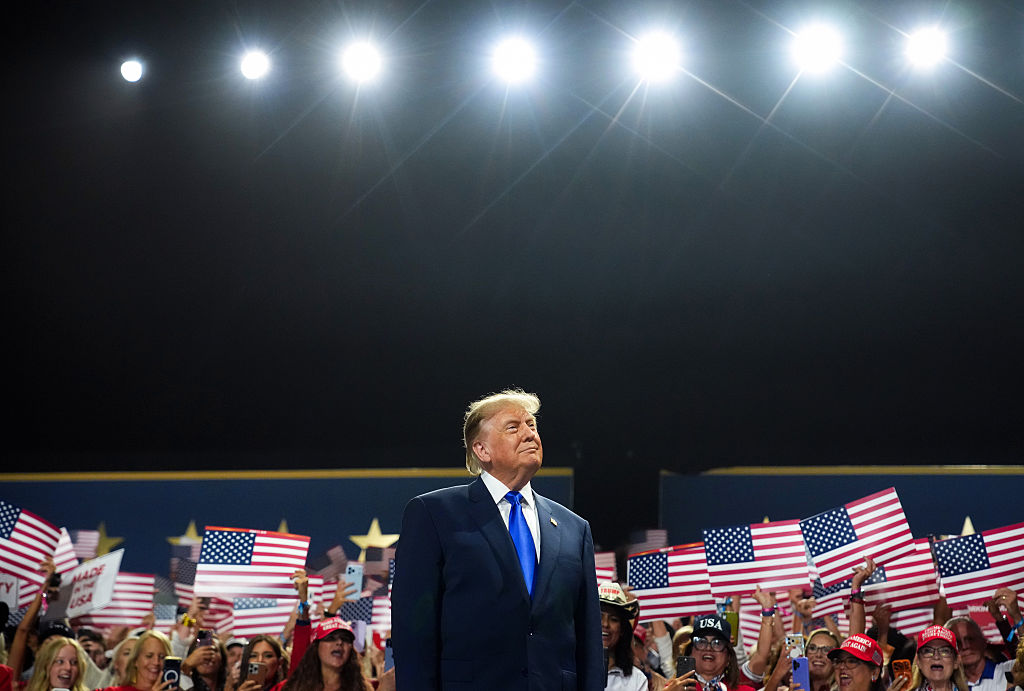
President Donald Trump has made artificial intelligence a major part of his economic and national security agenda, repeatedly calling for the U.S. to remain ahead of China while promoting rapid development of the technology.
Read more Trump Dismisses AI Safety Alarm, Says US Already Has Tools to Police Industry
Anthropic CEO Dario Amodei has called for a framework to slow development enough to better manage those risks, while other AI executives have backed the idea. On Sunday, Trump pushed back against the recent warnings to address potential risks.
“We’re leading China in AI. We’re the most sophisticated country in the world, and frankly I want to keep it that way because whoever wins AI wins,” Trump told reporters in Ireland.
Trump’s comments are consistent with themes he has returned to throughout his second term. Here are some of his most notable statements about AI.
‘Whoever wins AI wins.’
Trump made the comment Sunday when asked whether the AI industry should slow down or face greater regulation. He said the U.S. is currently leading China and argued that maintaining that lead is critical.
His comments came after researchers at Anthropic warned that increasingly capable AI could pose severe risks – including a potentially existential threat to humanity. Trump has taken the opposite position, saying concerns about catastrophic outcomes are being exaggerated.
For his part, Chinese President Xi Jinping has sent conflicting signals on AI – publicly stating that the technology shouldn’t exceed people’s ability to control it, but also that China shouldn’t let the U.S. be a unilateral power in the field.
“We should ensure that AI is always under human control,” he said at a July AI conference in China. He shortly after added, “Meanwhile, we should jointly oppose overstretching the national security concept in the field of AI and placing one country’s security over that of others.”
‘If you regulate them too much, you kill the source of American genius and technological power.’
Trump made that argument at a White House AI summit in July 2025, where he outlined his administration’s approach to the technology.
He said the U.S. should pursue regulation that is “sensible” and “smart” but argued that excessive restrictions would hurt startups and other companies that drive innovation.
“You’re going to have regulation, but it’s going to be sensible, smart regulation,” Trump said.
Trump has made reducing regulatory barriers central to his AI policy. His January 2025 executive order called for removing policies that the administration viewed as obstacles to American AI innovation and said the U.S. should “sustain and enhance” its global AI dominance.
‘The greatest threat of all is to forfeit the race.’
At the July summit, Trump tied AI development directly to the competition with China.
“The greatest threat of all is to forfeit the race and force our partners into rival technology,” he said, arguing that the U.S. should maintain national security protections without restricting American technology so much that other countries turn to Chinese alternatives.
Read more Bayer’s Monsanto Unit Urges Missouri Judge to Approve $7.25 Billion Roundup Settlement
Trump also said his administration wanted to make the U.S. an “AI export powerhouse,” including by expanding exports of American chips, software and data-storage technology.
READ:
Just How Bad Is Inflation Now?
‘It will mean higher wages and more opportunity for millions.’
Trump has also emphasized AI’s potential economic benefits, particularly through new jobs. Job loss due to AI implementation is a key concern for many American workers, particularly younger people who are seeing entry-level positions phased out.
At the July 2025 summit, he said investments in AI infrastructure would create jobs for energy workers, HVAC technicians, engineers and electricians.
“This colossal investment in AI infrastructure and many other industries, for that matter, such as automobiles and so many other things, will also create thousands and thousands of great paying jobs, the kind of jobs we want, including lots of blue-collar jobs,” Trump said. “And our numbers are very good right now, but when you see these numbers in two years from now, it will mean higher wages and more opportunity for millions of energy workers, HVAC technicians, engineers, electricians and the hard-working citizens who make our country run.”
He also pointed to billions of dollars in planned investments by major technology companies and argued that building infrastructure – including data centers – would generate economic activity beyond the technology sector. The endorsement comes as opposition to data centers emerged as one of the few issues Republicans and Democrats agreed on this primary season. Many see the facilities as a strain on power and water supplies and a driver of utility bills, while offering few jobs or local benefits in return.
Trump has repeatedly linked AI development with broader economic goals, including increased domestic energy production and construction.
‘The U.S. government will deal only with AI that pursues truth, fairness and strict impartiality.’
Trump has also focused heavily on what he considers ideological bias in AI.
At the July 2025 summit, he said the federal government shouldn’t procure AI systems that incorporate partisan or ideological agendas. He signed an executive order that day to prevent the federal government from procuring AI the administration considers ideologically biased.
That approach builds on Trump’s January 2025 executive order that said American AI systems should be free from “ideological bias or engineered social agendas.” The order revoked a Biden administration AI executive order and directed federal agencies to review policies created under it.
‘A lot of very negative forces’ are raising concerns that ‘won’t happen.’
Trump returned to the question of AI risks Sunday, arguing that some warnings about the technology issued by prominent voices across the industry from OpenAI CEO Sam Altman to tech titan Bill Gates are overstated.
“We could put guardrails. We can do this and that,” Trump said. “But I think you have a lot of very negative forces that are bringing it up that shouldn’t be bringing it up and they’re bringing up things that won’t happen.”
The comments came as the debate over AI safety has intensified. Some industry leaders have called for a slower pace of development, while Trump has continued to emphasize speed, investment and maintaining the U.S. lead over China.
Taken together, Trump’s comments show a consistent emphasis on American AI dominance, competition with China, economic growth and limiting what he considers excessive or ideological regulation. His recent remarks also suggest that he views warnings about extreme AI risks as less pressing than the need to ensure the U.S. doesn’t fall behind in the technology race.
Read more OBITUARY-Bob Mackie, Fashion Designer for the Stars, Dies at 87