







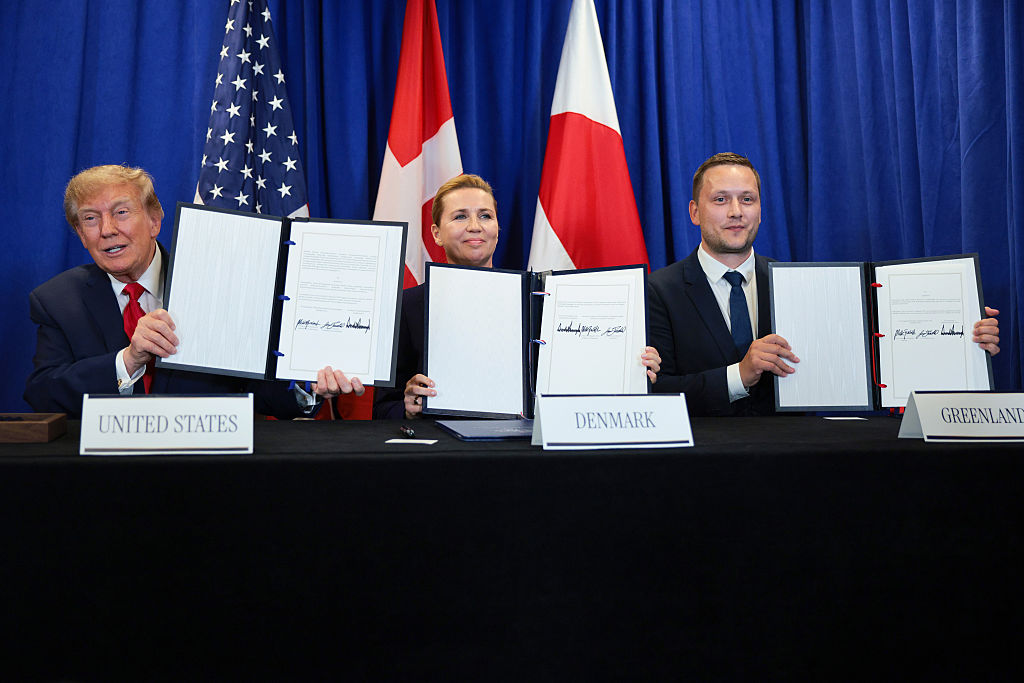
President Donald Trump, Danish Prime Minister Mette Frederiksen and Greenland Prime Minister Jens-Frederik Nielsen signed a new security agreement on Tuesday to expand military cooperation in the Arctic.
Read more Exclusive-Hacked FBI Data Has Sensitive Information About Employees’ Intelligence Roles
The agreement represents a shift from Trump’s earlier calls for the United States to acquire Greenland. Rather than transferring control of the territory to the U.S., the agreement expands the American military presence there while placing greater emphasis on NATO’s role in Arctic security.
Here’s what to know about the deal and what it means for Greenland, Denmark and the U.S.
What Does the Greenland Security Deal Do?
The agreement allows the U.S. to expand its military infrastructure in Greenland, including establishing two additional military sites at Narsarsuaq in southern Greenland and Mestersvig on the island’s east coast.
Narsarsuaq was once the site of a U.S. military base known as Bluie West One, which the U.S. closed in the 1950s. Mestersvig is currently used by Denmark’s Sirius Dog Sled Patrol, a military unit responsible in part for enforcing Danish sovereignty in the remote region.
The agreement also allows the U.S. to establish a “Golden Dome” missile defense system in Greenland to defend against ballistic missile threats. Greenland’s location between North America and Europe makes it strategically important for monitoring and defending the Arctic and North Atlantic.
The deal amends the 1951 U.S.-Denmark defense agreement that provides the legal foundation for the American military presence in Greenland.
Why Is Greenland So Important to the U.S.?
Greenland occupies a strategically important position in the Arctic, sitting between North America and Europe and along routes that could be used by military aircraft and missiles.
The U.S. already operates Pituffik Space Base in northwestern Greenland, where American forces conduct missile-warning, missile-defense and space-surveillance missions. Roughly150 U.S. military personnel are currently stationed there.
The Arctic has also become increasingly important as Russia, China and the U.S. compete for military and economic influence in the region. Greenland has significant mineral and energy resources in addition to its strategic location.
During the Cold War, the U.S. maintained 17 military installations and more than 10,000 personnel in Greenland. The new agreement would mark the first major expansion of U.S. military infrastructure on the island since then.
Read more Analysis-As 5% Treasury Yields Lose Shock Value, Investors Start Worrying About 6%
Does the Deal Give the U.S. Control of Greenland?
No. Greenland remains a self-governing territory within the Kingdom of Denmark.
Trump has described the agreement as giving the U.S. “permanent control over security and all other needs” in Greenland and said U.S. adversaries wouldn’t be permitted to establish a military presence or make sensitive investments there without American approval.
Danish officials, however, have emphasized that the agreement strengthens NATO’s role in Arctic security and respects Greenland’s right to self-determination. Danish Foreign Minister Lars Løkke Rasmussen said the arrangement would ensure that Arctic security isn’t left solely to Washington and Copenhagen, but would involve NATO more broadly.
Greenland’s government has likewise emphasized its continued autonomy. Greenland Prime Minister Jens-Frederik Nielsen said Tuesday that NATO has an important role to play in the Arctic.
How Did the U.S. Get Here?
The agreement follows months of tension over Trump’s campaign to acquire Greenland.
Trump repeatedly argued that the U.S. needed control of the territory for national security reasons and, at times, declined to rule out military action or economic pressure to obtain it. Those comments triggered a diplomatic crisis with Denmark, a NATO ally, and prompted negotiations over ways to address U.S. security concerns without transferring sovereignty.
Greenland’s population is roughly 57,000, and polling has shown strong opposition among Greenlanders to becoming part of the U.S.
The new agreement therefore leaves Greenland’s political status unchanged while significantly expanding the U.S. military’s potential role on the island.
What Happens Next?
The immediate focus will be on implementing the agreement, including developing the additional military sites and determining how the proposed missile defense system will be built and operated, Trump said.
The deal also creates a new framework for U.S., Danish and Greenlandic cooperation on Arctic defense. NATO has welcomed the agreement, describing it as a step toward greater security, stability and cooperation in the region.
For now, the agreement represents a compromise between Trump’s demand for greater American control over Greenland’s security and the insistence of Denmark and Greenland on maintaining Greenland’s sovereignty and self-determination.
Read more US CDC Confirms First Measles-Related Death of 2026