









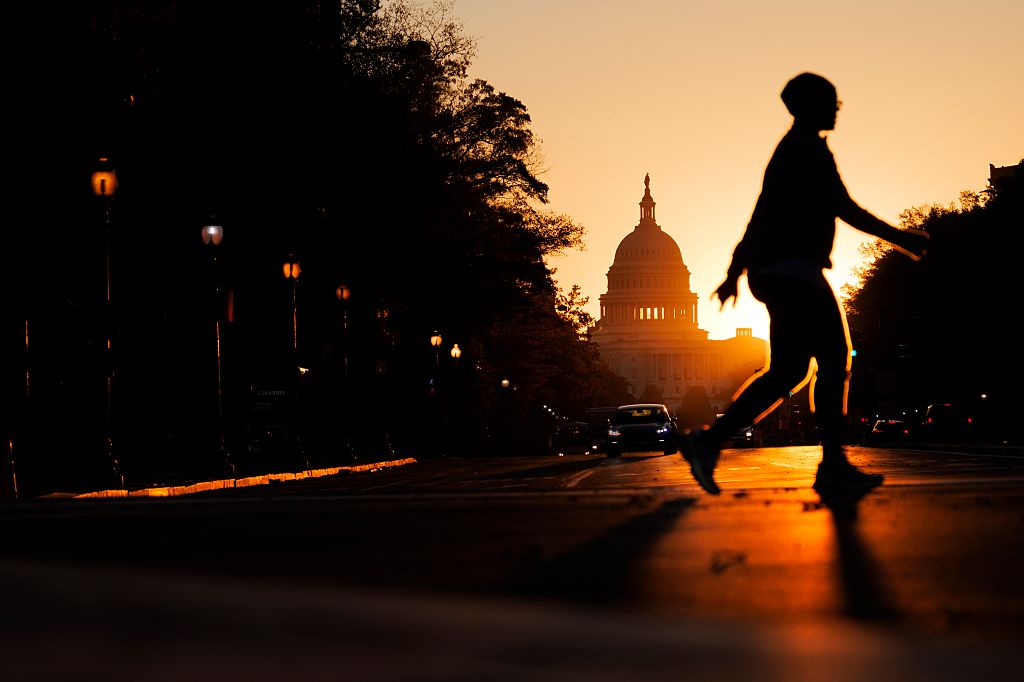
On Tuesday, in a 308-117 vote, the House passed the Sunshine Protection Act – a bill to make daylight saving time permanent.
Read more How Many Senators Have Died in Office? The Senate’s Long History of Loss
Bills and resolutions to make DST permanent have been introduced over 450 times in state legislatures, while federal legislation has been proposed 10 times. Yet, until this year – DST has never made it to the House floor for a vote. With newfound advocacy from President Donald Trump, the bill passed the House.
Yet, it faces an uncertain future in the Senate. Making DST permanent remains a contentious move – with both advocates and detractors citing community health as their primary motivation.
What Is Daylight Saving Time?
Daylight saving time is the practice of moving clocks one hour ahead to make better use of sunlight. In 1918, Congress passed the Standard Time Act which established five time zones and set dates for summer daylight saving time. Passed during World War I, the Act sought to decrease the consumption of energy sources such as gas and oil. During World War II the nation implemented year-round daylight saving time or “War Time.” After the war, local jurisdictions could choose to observe DST or not.
Since then, DST has remained a contentious policy across the United States. On the second Sunday of March at 2 a.m. clocks are rolled forward an hour for daylight saving time. In the winter, days become shorter, and the sun sets sooner. Therefore, on the first Sunday of November at 2 a.m., the clocks return to standard time and are rolled back an hour, returning daylight to the mornings.
Under the Sunshine Protection Act, the nation would “ditch the switch.” The spring and summer schedule would become permanent; the winter schedule would no longer be in effect. Daylight would begin later and last longer year round.
What Do Supporters of Permanent DST Say?
Supporters of DST in the House pointed to two key rationales: public safety and community health.
Sleep deprivation has often been cited as a driving force behind fatal automobile accidents. A 2016 study by the American Economic Journal found that the spring transition into DST caused over 30 deaths annually at a social cost of $275 million. Proponents say that a permanent schedule would reduce the disruption to sleep patterns and resulting roadtime groginess, saving lives.
Representatives also pointed to the extra hours of sunlight as time for Americans to engage in outdoor recreation and physical activity, promoting both health and quality of life.
“Permanent daylight saving time will improve public safety, promote healthier and more active lifestyles and give families more daylight to enjoy after work and school,” said Rep. Vern Buchanan, a Florida Republican.
Proponents have branded the legislation as “common sense,” arguing that the twice yearly switch causes unnecessary confusion.
Read more Hegseth Announces Testosterone Screening for US Troops
“For years, Floridians have made it clear that they are tired of the outdated and unnecessary practice of changing the clocks twice a year. The biannual time change disrupts daily routines, inconveniences families and businesses, and no longer reflects the needs of our modern economy,” said Rep. Gus Bilirakis, a Florida Republican. “Establishing permanent daylight saving time will provide Americans with greater consistency, more usable daylight in the evening, and the certainty that comes with ending the twice-yearly clock changes.”
Why Do People Oppose DST?
Yet, not all are happy with this bipartisan bill. In regions of the country already at extreme ends of various time zones, a permanent DST may pose more problems than solutions.
For many in Arkansas, daylight saving time “would mean the sun wouldn’t rise until after 8:00 or even 8:30 a.m. during the dead of winter. Three months out of the year, kids in towns like Bentonville, Fayetteville, and Fort Smith would start school ahead of the sun,” said Sen. Tom Cotton in his opposition to the Act last year.
Cotton argues that for states in extreme northern and western time zones, the effects would be even more brutal.
“For instance, the sun wouldn’t rise until nearly 9:00 o’clock during winter in Seattle. In Grand Rapids, (Michigan,) the sun would rise as late as 9:15 a.m., and in Williston, North Dakota, they would not see the sun ‘till almost 9:45 a.m.”
In those areas, school children and those heading to work may have to take the bus or commute entirely in darkness.
“Meanwhile, construction workers, farmers, and others who rise before the sun or need the sun to work would be penalized. These workers might go three, four, even five hours in the morning without seeing the sun, which would hurt their quality of life and potentially their safety in the workplace,” Cotton said.
The bill does allow states to opt out – remaining on permanent standard time, which is currently observed in Hawaii and most of Arizona.
The bill, now having passed the House, will be moving to a vote in the Senate, where Cotton is predicted to continue his dissent, joined by a host of over a dozen other Republicans and Democrats, hailing from states ranging Mississippi to Delaware.
Read more Soccer-A Place Called Home: US Soccer’s Hope for the Future