








President Donald Trump’s proposed triumphal arch near Arlington National Cemetery has undergone a significant change in purpose since the project was first presented as a monument commemorating the nation’s 250th anniversary. The 250-foot structure was designed to include public spaces, exhibits and an observation deck, but Trump said Sunday that he had agreed to turn it into what he called a “top grade Military Complex/Triumphal Arch.”
Read more Trump Arch Drone Plan Needs FAA Review, Lawmaker Says
Trump said the change came at the “strong request” of the U.S. military and would allow the structure to house and rapidly deploy large numbers of drones, as well as provide positions for snipers and storage for sniper ammunition. The Pentagon hasn’t publicly provided additional details about the proposed changes beyond Trump’s announcement.
Here’s what is currently known about what would be inside the arch.
What Is Already Planned Inside the Arch?
The most detailed publicly available design comes from a June National Park Service assessment, which describes a five-level structure containing about 70,000 square feet of space. The Park Service says those plans are preliminary and “may not reflect the final design.”
The ground level would include security screening, lobbies and other back-of-house functions. Two mezzanine levels would contain mechanical and support spaces. Above those would be a public gallery level with exhibit space, restrooms and circulation areas, with the possibility of a cafe and gift shop.
The plans also call for six stairways and five elevators, including a dedicated elevator serving the observation deck.
What Would Visitors Actually Be Able To Do There?
The arch was designed as a public attraction with a timed-entry system similar to the Washington Monument. Visitors would enter through a security screening area before proceeding into the public portions of the structure.
The gallery level would provide exhibit space and visitor amenities, while the observation deck would offer nearly 9,812 square feet of exterior space about 162 feet above ground. The deck would provide views toward Washington and Arlington, including surrounding landmarks.
The plans also envision a public plaza surrounding the arch, with pedestrian improvements and security features including surveillance cameras and controlled access.
Where Would the Military Features Go?
That part of the proposal is considerably less clear.
Trump said the arch would be able to “house, store” and rapidly use large numbers of drones, with snipers positioned on both the roof and plaza and “large quantities” of sniper ammunition stored inside.
However, the Park Service’s June plans don’t describe drone facilities, sniper positions or ammunition storage. Those documents instead describe the arch primarily as a monument and visitor facility.
No revised architectural plan has yet been publicly released that details how Trump’s newly announced military functions would fit into the structure. The administration also hasn’t publicly explained what military operations would take place there or identified a specific facility within the arch for those purposes.
That distinction matters: The military components have been announced by Trump, but they aren’t yet reflected in the detailed Park Service design documents that are publicly available.
Read more Trump Says US Will Keep Buying Canadian Potash, Belarus Would Sell at Lower Price
The shift toward describing the arch as a national security facility could also have considerable implications for the legal and regulatory fight over the project. The administration’s new framing echoes its approach to the White House ballroom, where national security arguments have become part of the legal justification for continuing construction.
The timing for announcing the new purpose of the arch is notable because the Park Service recently acknowledged that the structure would have unavoidable effects on historic properties and views in Washington and outlined measures to mitigate those effects. However, it is not yet clear whether designating the arch as a military facility would allow the administration to bypass specific reviews or approvals required for the project. Nor is it clear how a facility storing weapons and ammunition would affect the movement of civilian tourists as well as the vehicle flow through a heavily traveled traffic circle.
What Else Would Be on the Monument?
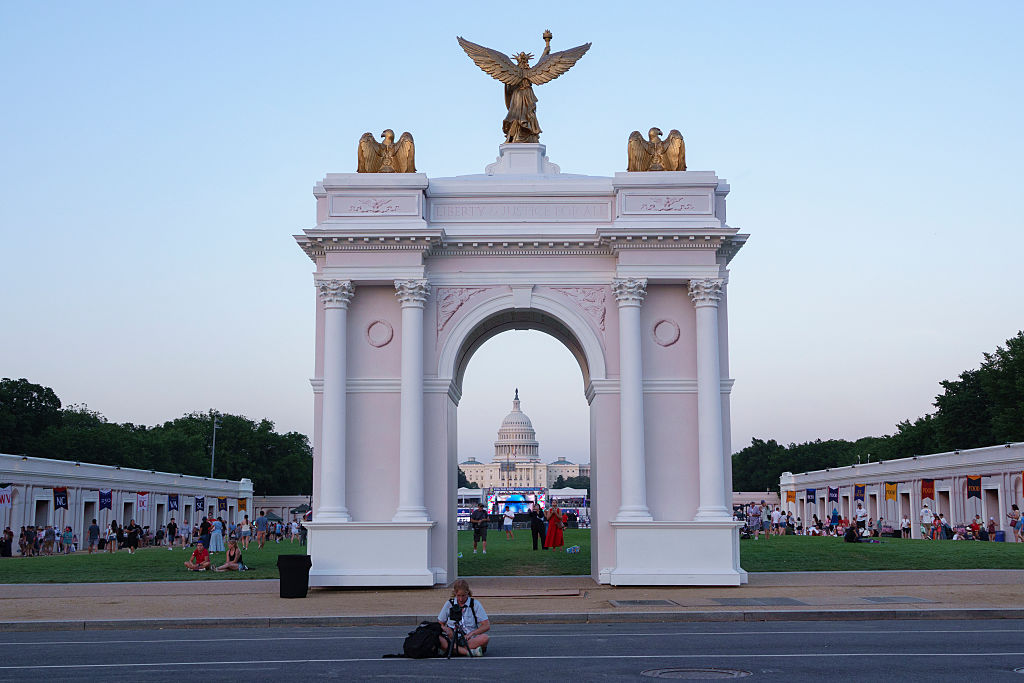
The exterior would be made of reinforced concrete clad in granite. Above the two legs of the arch would be two eagles, with a larger winged figure positioned at the center. Those statues would extend the structure’s height to roughly 250 feet.
The Federal Aviation Administration has also determined that the structure wouldn’t pose a hazard to aircraft if certain visibility measures are included. Those measures include a continuously illuminated “eternal flame” at the top and floodlights aimed at the arch so pilots can see it. Those determinations were made, though, before the recent announcement. No details have been provided about what accommodations might have to be made to allow for the use of military drones from the structure through the flight path of a busy airport.
How Big Is This Thing?
The arch would stand about 250 feet tall, making it one of the most prominent structures in Washington. The main architectural portion would rise about 166 feet, with the statues bringing the total height to 250 feet. It would be about 166 feet wide, with a 55-foot-wide opening. By comparison, the Washington Monument stands right around 555 feet – making the arch a little less than half its size and one of the most prominent features in the skyline of the nation’s capital.
Trump has compared the project to Paris’ Arc de Triomphe and has said the Washington structure would be larger.
Are These Plans Final?
No. The Park Service explicitly describes its architectural drawings as preliminary, and the project remains subject to legal and regulatory challenges.
A federal judge ordered the administration in September to provide advance notice before taking action at the site, with an exception for work involving the identification of underground cultural artifacts. Veterans challenging the project argue that it would interfere with the historic relationship and sightline between the Lincoln Memorial and Arlington National Cemetery.
The FAA’s determination also isn’t yet completely final: Interested parties have until Oct. 18 to petition for review, with the determination scheduled to become final Oct. 28 absent further action.
For now, the most detailed plans still show a monumental public attraction with exhibits and an observation deck. Trump’s announcement adds a proposed military role, but exactly how – or whether – drones, sniper positions and ammunition storage will be incorporated into the final structure remains to be established.
Read more Exclusive-Microsoft to Keep Shareholder Proposal Rights Through 2027, Even as SEC Reduces Oversight