

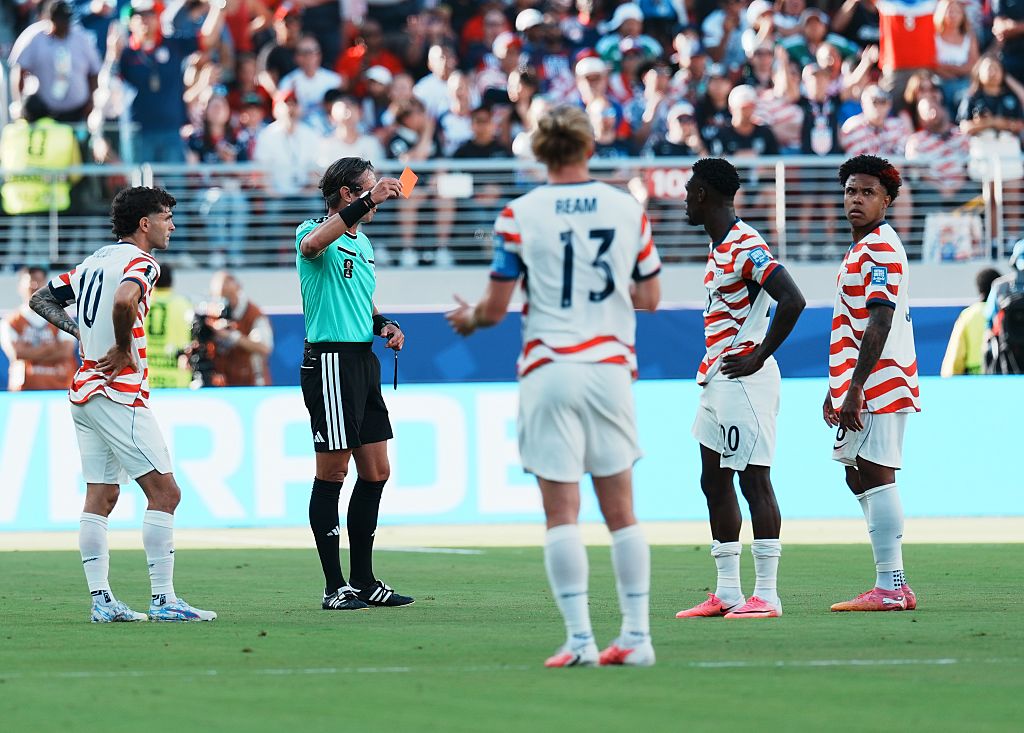
For all the talk of the very real transatlantic tensions over aid to Ukraine and war with Iran, the NATO summit that kicked off today could be overshadowed by something much smaller: the global controversy over FIFA’s decision to allow star U.S. striker Folarin Balogun to play in last night’s game against Belgium.
Read more Democrats Call for Platner to Withdraw From Senate Race
Not that it mattered much on the field. Balogun was a non-factor as the more experienced and talented European side sent the hapless U.S. team crashing out of the tournament with a 4-1 thrashing. But how he got to the field became a matter of international debate after the automatic suspension that followed his prior-round red card was lifted by FIFA in an intervention that hadn’t happened since 1962.
The impact on the summit’s diplomatic pitch, though unclear at the moment, could be similarly discomfiting after President Donald Trump confirmed he personally reached out to FIFA about the suspension, giving the impression that political pressure, not independent sporting judgment, led to his return.
The summit will bring Trump face to face with leaders from countries definitely more passionate about soccer than the United States has been historically – and for whom the brouhaha is a story about politics and economics as well as sportsmanship.
If this all feels a little silly to you, consider that soccer is the most-watched sport in the world and generates enormous amounts of national pride and billions of dollars in economic activity. Politics could never be far behind when those forces are involved.
The incident’s potential to upstage the NATO gathering was made clear when Secretary of State Marco Rubio was asked about it as he met with Chilean Foreign Minister Francisco Pérez Mackenna.
“Maybe it’s turning into an international incident. I don’t know,” he said. “Maybe we’ll bring it up at NATO tomorrow when we’re there with the Belgians and everybody else.”
Trump’s Role
In the Oval Office on Monday, Trump confirmed he had called FIFA chief Gianni Infantino.
“I didn’t tell him what to do,” said Trump, who admitted he didn’t know what a red card was before this hullabaloo. “All I did: I asked for a review because I didn’t think it was a foul.”
Read more Today’s News: Trump Takes On NATO as U.S. Knocked Out of World Cup
Infantino confirmed Trump called him but downplayed the significance of the call, saying FIFA’s “independent judicial bodies” handled the controversy. The organization later rejected Belgium’s appeal.
Trump encountered Belgian Prime Minister Bart De Wever at group events at the summit but does not have a scheduled one-on-one meeting with him. Overnight, though, an Instagram account featuring De Wever’s cat trolled Trump with a picture of the pet holding a Trump plushy with the thought bubble “I slept so well! You too?”
Soccer and ‘Soft Power’
The World Cup – co-hosted by Canada, Mexico and the United States – has largely been a big success both on the field and off the field, with foreigners discovering that the real America is much more than the headlines.
But the red card row may blunt any gains for the U.S. in terms of “soft power,” the international relations concept of being able to get other countries to do what you want through attraction and persuasion rather than coercion or payment.
On Sunday, Alexi Lalas, a former American defender and a lead soccer analyst for Fox Sports, called the reversal “great news” but said “it’s now (even more so) U.S. vs. world.”
“Any support, affinity, or benefit of doubt from (the) rest of (the) world just went out the window. Applies to refs too. Bring it on!” Lalas said in typically measured fashion.
While he seemed to be referring to on-field play, there’s a non-zero chance that Trump’s involvement in the controversy – the idea of the U.S. flexing its muscle to get special treatment – will reinforce the view of America’s critics that we’re more bullies than Buc-ee’s.