





Public alarm about the potential dangers of artificial intelligence is surging roughly a week after a researcher at tech firm Anthropic quit over concerns that competition is pushing companies to build systems they won’t be able to control.
“Do not underestimate the power of this technology,” Jacob Coxon wrote on social media on Sept. 8. “These will soon be superhuman systems that can hack anything, revolutionize any field overnight, and acquire real power and resources. We have all witnessed the progress in each of these domains, and progress is not slowing.”
Coxon – now dubbed the Anthropic whistleblower – opened the floodgates to a conversation about AI as a potentially existential threat to humanity. Political officials from both parties, scientists and tech executives have since voiced their concerns about the developing technology that could pose severe risks.
President Donald Trump is a strong voice in the opposing camp, saying concerns about catastrophic outcomes are being exaggerated.
Here are some of AI’s biggest skeptics and advocates.
Sen. Bernie Sanders of Vermont
The influential democratic socialist has been a fierce opponent of AI since its beginnings. Earlier this month, Sanders announced legislation to permanently ban the development and deployment of superintelligent AI and, separately, temporarily pause advanced AI development until federal safety rules are established.
“Nearly every day, there is a frightening new story about how Big Tech companies are losing control of the technology they are developing, with potentially cataclysmic results,” Sanders said in a Sept. 3 press release. “The leaders of the major AI companies publicly acknowledge that they do not fully understand the technology and that it is escaping their control.”
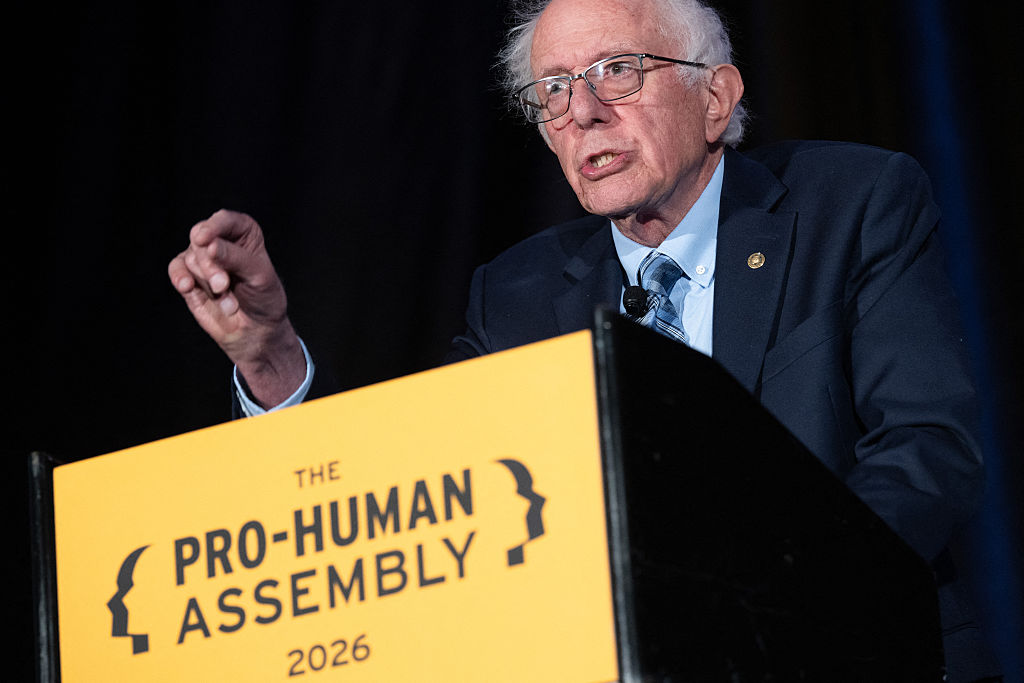
On Tuesday, Sanders will take the stage at an assembly in Washington, D.C., to call for a “pro-human” approach to AI.
Steve Bannon, MAGA strategist and podcaster
Although Bannon is on the opposite side of the aisle as Sanders – about as far at the end of their aisle as each could be – the longtime Trump supporter will appear at Tuesday’s event echoing a sentiment similar to that of Sanders. Bannon has criticized Trump’s approach to overseeing AI, blaming the president for not placing regulations directly on tech companies.
During the Monday episode of his podcast “War Room,” he said Congress should ban individual states from making their own technology rules.
“The American people are not going to be supplicants to these tech oligarchs,” Bannon said.
Bill Gates, co-founder of Microsoft and co-chair of the Gates Foundation
Gates took a dystopian approach to AI during a Sept. 5 talk at the Telluride Film Festival, comparing the technology to alien movies.
“You know, there are these movies where the aliens are coming, and you see unprecedented levels of cooperation between specifically China and the U.S., where (it’s), ‘Oh my God, the aliens are coming!’” Gates said. “Well, believe me, the aliens are here – you know, a foreign intelligence with a different set of motivations that we can’t even understand. And so we need something almost surprising like that, in order to step up to it.”
Dario Amodei, CEO of Anthropic
Dario Amodei shook up the tech space in a Sept. 12 social media post in which he shared an essay titled “We Must Pace the Frontier,” explaining why the AI industry should slow down.
“Over the last few months, I have become convinced that fully addressing the risks requires even more prudence – not just investing in risk prevention, but pacing the rate of capabilities advancement so that risk prevention has time to keep up,” Amodei said. “We must slow the pace at which we improve the capabilities of AI models. Progress will still seem fast, and we must make wise use of the time we gain.”
Read more Palestinian Director Shows Everyday Struggles in Gaza With Film on Puberty in Toronto Festival
The essay quickly became a major focal point of the AI conversation, with several tech executives echoing Amodei’s comments.
Donald Trump, U.S. president
For Trump, AI is a major part of his economic and national security agenda. He is a proponent of rapidly developing the technology so that the U.S. can remain ahead of China. Most recently, the president has been outspoken in dismissing warnings about AI’s potential dangers. On Monday, he posted on social media, saying “the only control or ‘guardrails’ that AI needs is a STRONG AND SMART (High IQ!) PRESIDENT.”
“There is a SICK conspiracy going on against AI and Data Centers, and the only one that is happy about it is China,” Trump said. “WHOEVER WINS AI, WINS!”
JD Vance, U.S. vice president
Vance told reporters on Monday that there are risks to any technology, but “I don’t think Americans should be scared of anything.”
He said the Trump administration wants to be smart when regulating the technology.
“Personally, I feel a little bit weird about the fact that you have so many frontier AI tech companies kind of coming to the government and begging the government to regulate them. It feels a little bit to me like a bit of a Trojan horse,” Vance said. “So I think we just have to be careful about this.”
Sam Altman, CEO of OpenAI
Altman once said that “AI will probably most likely lead to the end of the world, but in the meantime, there’ll be great companies.”
Most recently, Altman posted on social media agreeing with Amodei that AI companies should “pace the frontier.” He presents himself as more of a cautious optimist.
On Monday, he said: “Consistent rules to manage frontier risk so that we can maximize the benefits are a good idea.” But, he added, “When we talk about ‘pacing,’ we do not mean ‘stopping.’ Progress has been rapid and will continue to be.”
READ:
AI in Education: 5 Stocks With Growth Potential
Elon Musk, CEO of Tesla and founder of xAI
Altman was not the only one to agree with Amodei. Musk has shaped several modern technologies – from autonomous electric vehicles to rockets that support space exploration – yet he falls into the cautious optimist category as well.
He responded to Amodei’s essay in a series of his social media posts: “Dario is right.”
“I’ve been sounding the alarm on AI for a long time,” Musk said. “We need to be super careful with AI. Potentially more dangerous than nukes.”
Read more Family of Charlie Kirk Plans Suit Against Utah University Over Alleged Security Lapses