







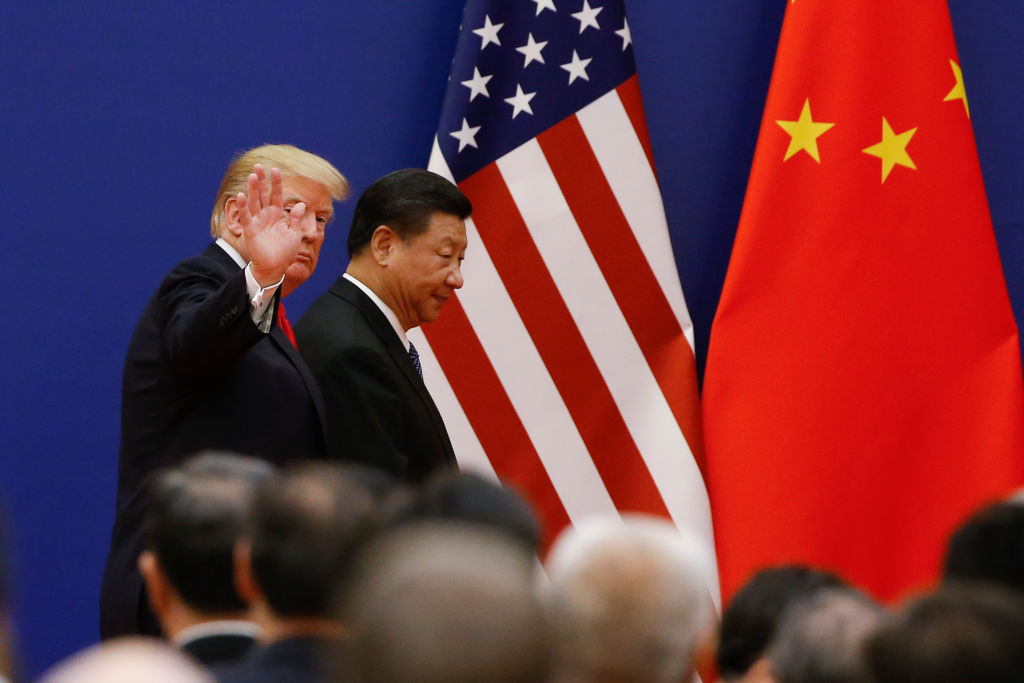
The leaders of the two most powerful countries in the world – U.S. President Donald Trump and Chinese President Xi Jinping – meet in Beijing on Thursday with exceptionally high stakes as the Iran war drags on and the economic rivalry between the two global superpowers ramps up.
The last U.S. state visit to China was nine years ago, when Trump went during his first presidential term in 2017. This time, he will have more company: 16 chief executives of major U.S. companies, including Apple CEO Tim Cook and Tesla head Elon Musk, will join Trump in Beijing.
Trump is expected to receive an elaborate welcome when he arrives in Beijing – red carpets and all – but perhaps not as extravagant as last time’s so-called “state visit-plus” due to rising tensions, experts predict. After a welcome ceremony and one-on-one discussion, Trump and Xi will tour Beijing’s Temple of Heaven.
Will the summit lead to a strengthening of the leaders’ relationship, or of their rivalry?
“What’s been striking so far is that there has been stability in the relationship,” says Jonathan Czin, former director for China at the National Security Council during the Biden administration and current fellow at the Brookings Institution. “It’s been proven surprisingly resilient, but it is very shallow and fragile.”
Trump’s approval ratings among Americans are suffering as the Iran war drags on and increasingly hits people’s wallets. But even before the war, China topped the U.S. in global approval rankings by the biggest margin in the past 20 years, according to a Gallup poll released in April.
While China would usually “play nice” ahead of its meeting with the U.S., this time, China is “skirmishing” and attempting to brandish its power “because they feel like they can do that with impunity,” says Czin.
What Will Trump and Xi Discuss at the Summit?
The U.S.-China relationship is experiencing tension on multiple fronts. The economic war between the two is escalating as the Trump administration tries to decouple from China and imposes steep tariffs on Chinese goods.
Most of Trump’s proposed tariffs were struck down by the Supreme Court in February, including a 145% levy on Chinese imports.
The leaders are expected to discuss the creation of a Board of Trade to continue talks about economics, energy, aerospace and agriculture, although Czin gets the sense that the U.S. is more keen on the idea than China.
“I fully expect the administration to tout whatever comes out of this meeting as being a big deal, and I would counsel skepticism,” says Jonathan Czin, former director for China at the National Security Council during the Biden administration and current fellow at the Brookings Institution.
Read more Trump’s Influence Faces Test as Voters in 6 States Head to Primaries
Where Does Taiwan Fit In?
American allies in the Far East fear that Xi will push Trump to firmly oppose Taiwanese independence – and possibly even to “recognize” Beijing’s claim that Taiwan is a part of China, rather than merely “acknowledging” it, according to Chinese analysts.
If Trump concedes, Taiwan’s ability to defend itself against a potential Chinese attack would be significantly weakened.
For China, the juice might not be “worth the squeeze,” says Czin.
“I think one of the limiting factors for [Trump] is he doesn’t want a headline that says that he’s been weak on China or that he’s made some kind of big concession.”
But the president is known to make impulsive decisions, Czin notes, so no one can be certain about what Trump will do.
The Strait of Hormuz Standoff: Will Xi Use His Influence?
There are rumors that Xi will agree to use his influence over Iran to reopen the Strait of Hormuz if Trump abandons Taiwan, but Czin says “trading a damaging concession for a promise from China” would have negative ramifications and “destroy the trust in U.S. commitments.”
Czin thinks that China may have orchestrated last week’s visit of the Iranian foreign minister to “deflect U.S. pressure” on the Strait of Hormuz issue ahead of Trump’s visit.
The AI Factor
Trump and Xi will also discuss the artificial intelligence technology that is another focal point in their rivalry.
Czin says the presence of Trump’s big tech allies will “underscore to Beijing that the Trump administration is focused on commercial relations and making business deals more than they are on geopolitical competition and security issues.”
The interpersonal dynamic between the two leaders is another layer Czin finds interesting. Trump and Xi “are so mismatched in so many ways,” he says. Trump sees himself as a dealmaker, while Xi operates like a jack-in-the-box, says Czin.
“He winds up for years, sometimes decades, and then he strikes when the moment’s right.”
Read more Trump Tightens Grip, Exacts Revenge With Big Wins in Republican Primaries