







BETHLEHEM, Pa. — The dominant theme of this year’s midterm elections has been how voters feel about Donald Trump’s second term as president. But with Trump’s approval ratings at historical lows, the Republican incumbent in Pennsylvania’s critical 7th Congressional District is trying to make it about something else: the personal faults of his opponent.
Read more GOP’s Byron Donalds Courts Black Voters in Bid to Become Florida’s First Black Governor
The 7th District spans Lehigh County and Northampton County in the Lehigh Valley of eastern Pennsylvania, with the remainder covering rural Carbon County and a portion of Monroe County. The district has an industrial heritage: The Lehigh Valley – home to the cities of Bethlehem and Allentown – became a symbol of Rust Belt decline but has rebounded in more recent years, driven by growth in industries such as healthcare and transportation. The valley’s population has grown as well, fueled by an influx of Latinos, who account for more than a fifth of the district’s population.
Politically, the 7th is a swing district within a swing state. Trump won the district in 2024 by a 51% to 48% margin, and recent congressional races here have been competitive between the parties.
The race is competitive again this year, and the district’s seat could be a key building block for Democrats in assembling a majority in the House. It’s one of four tight 2026 House contests in Pennsylvania, and a sweep of those seats — which analysts consider plausible — would essentially erase the Republicans’ narrow majority on its own.
As Trump was winning the district in 2024, Republican Ryan Mackenzie was ousting a Democratic incumbent by an even smaller margin: 1 percentage point. Now, though, the political environment is far worse for Republicans running for Congress, especially for those whose voting record can be mined for alignment with Trump’s policies.
The 7th District race has been considered nip and tuck the entire midterm cycle. Mackenzie faces Democrat Bob Brooks, a longtime Bethlehem firefighter and president of the Pennsylvania Professional Firefighters Association.
Brooks does not have a college degree, and he leans into his blue-collar life story. Democrats have struggled to attract voters with a similar working-class profile in recent elections, and the party’s desire to reverse that trend helps explain Brooks’ pre-primary support both from moderates like Pennsylvania Gov. Josh Shapiro and progressives like independent Sen. Bernie Sanders of Vermont.
A September Franklin & Marshall College found Brooks leading Mackenzie 45% to 40%, while interviews and an early October visit to the district suggests the race could be slipping away for the GOP.
In a telephone conversation with U.S. News, Mackenzie highlighted his membership in the bipartisan Problem Solvers Caucus in Congress and his break from most House Republicans in voting to extend enhanced health insurance subsidies tied to the Affordable Care Act.
“Affordability in healthcare is something that we should be focusing on in a bipartisan way,” Mackenzie said.
Yet in framing the race’s top issue as a question of “trust,” Mackenzie began the interview by contrasting himself with Brooks, whom he called “a known racist.” “He is a crook, and he is a scumbag,” Mackenzie said. He repeated the “racist” and “crook” accusations later in the interview.
An aide followed up with details, referencing Brooks’ messy legal battle tied to money owed to his former mother-in-law; reports that Brooks did not disclose the debt when applying for COVID-19 relief funds and that he failed to purchase required workers’ compensation insurance for a lawn care business he owned; that he called union firefighters with side gigs as volunteer firefighters “scab(s)” and “sh–bags” on social media; an accusation aired in a blog post that he was allegedly a steward at a social club in the early 2000s that had an unofficial whites-only policy; and Facebook posts from Brooks that included one featuringpro-gun and far-right imagery not long after a mass shooting targeting Latinos in Texas.
The Brooks campaign vehemently denied the social club accusation, which has not been otherwise reported. They also pointed to the Democrat’s apology encompassing the social media post with the far-right imagery and said the legal dispute has been settled. Campaign spokesman Benny Stanislawski told U.S. News that Mackenzie “is desperately throwing whatever he can at the wall to see what sticks because he knows he can’t run on his own record.”
Read more AI, Tech Leaders Are Lobbying Trump Health Officials in a Government-Run Chat Room
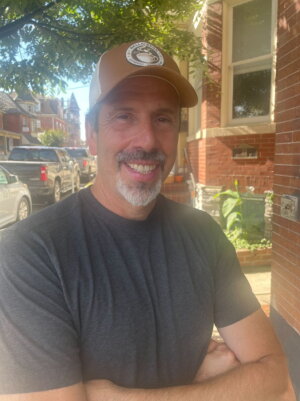
Louis Jacobson for U.S. News
Christopher Borick, a political scientist and longtime pollster in the Lehigh Valley, in Nazareth, Pennsylvania, on Oct. 3.
Christopher Borick, a political scientist and pollster at Lehigh University in Bethlehem, said that in this year’s political environment, Stanislawski is probably right that policy will outweigh personality.
“I understand why Mackenzie would target” Brooks personally, because Brooks is “rough around the edges,” Borick said. “It’s an age-old playbook. But I don’t know if it’s the playbook for the moment.”
Borick said he recently attended a town hall for older adults in the district where Mackenzie was present. The incumbent “got hit hard,” Borick said. “He got challenging questions on the Iran war, why he hasn’t broken with Trump, and gas prices — issue after issue.”
Meanwhile, Brooks, who has no prior experience running for public office, didn’t make the race as personal as his opponent during recent public appearances. In a pep talk to a packed room of volunteer union canvassers from the Pennsylvania State Education Association, Brooks urged “better pay, better working conditions, better health care,” and protections of rights for union members.
To the extent that Brooks is focusing on Trump, it’s that he says Mackenzie is enabling most of the president’s policies. “We have to point out Trump’s faults, but the reason we’re pointing out Trump’s faults is because we’re pointing out Mackenzie’s faults,” Brooks said in an interview after the canvassing event.
Mackenzie, he said, “can’t stand on his own record. That’s clear. So they just go after the other person.”
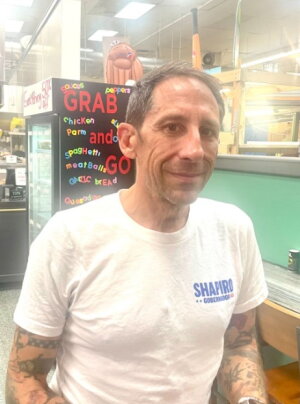
Louis Jacobson for U.S. News
Matt Tuerk, the mayor of Allentown, Pennsylvania, at his city’s farmer’s market on Oct. 3.
Matt Tuerk, the second-term Democratic mayor of Allentown, said the kinds of bread-and-butter issues the older adults pushed Mackenzie on during the town hall event are the ones that will occupy his constituents’ minds when they vote.
He said that people feel like Republicans, as the party in power in Washington, “are not really hearing them” and aren’t concerned enough about “what it costs to fill up a tank of gas, what it costs to bring a couple of bags of groceries home, what it costs to have your kid in childcare.”
He said that’s the case for Latinos, who account for about 55% of his city’s residents and who, according to polling, are turning against Trump this year amid concerns about both affordability and the administration’s immigration policies. Tuerk is Latino.
Even six months ago it was already too late for Mackenzie to start distancing himself from Trump, Tuerk said.
Read more FCC Chief Defers to Pentagon on Airing US Execution on TV Networks
“Bob Brooks has a ‘D’ after his name, and Ryan Mackenzie has an ‘R,’” he said.