




Banning journalists from the White House, justifying a triumphal arch, rejecting restrictions on artificial intelligence technology – the positions may be far afield of each other, but they have some commonalities. In addition to being publicly unpopular and legally uncertain, President Donald Trump in recent weeks has defended each one by invoking national security.
Read more Australian Developer Axes Sydney Suburban Data Centre Plan After Local Opposition
While the Trump administration has leaned on the national security argument often throughout his second term, the president seems to be finding new and more frequent uses for doing so.
And although the president generally holds unique power in the national security space, some analysts say the increasing absurdity of Trump’s justifications is diminishing that power.
“Courts do accord deference as a general rule to the president in matters of national security, but I think we are seeing courts appropriately skeptical of many of those invocations from this administration,” said Rachel Goodman, special counsel and program lead in free expression at Protect Democracy.
It’s not the first time a president has used national security powers, largely implemented after the 9/11 attacks, to justify actions that are otherwise legally dubious. Former Presidents George W. Bush and Barack Obama used such authorities, for example, to implement the no-fly list and surveil Americans under the Patriot Act.
But the debate over national security powers is entering a new realm – one that doesn’t seem particularly relevant to national security at all.
Building the Ballroom
The Trump administration’s announcement of construction plans for a White House ballroom last year immediately saw legal and public outcry over its lack of federal approval and the sudden destruction of the historic East Wing.
A federal judge in March issued an order halting construction, then – in a crucial distinction – clarified that order in April to allow the national security components of the project, mostly underground, to continue. An appeals court in August reached a similar conclusion.
A 5-4 Supreme Court decision last month is temporarily allowing work to proceed on the project while litigation continues after arguments based substantially on the national security aspects of the project. Since then, Trump has also emphasized those features, proposing adding bomb shelters, underground medical and military facilities, a “drone-proof” metal roof and bulletproof glass.
“The president was talking about the need for a ballroom for a long time, just kind of as a better entertaining space, and then it was only once the challenge was in court and had been in court that the president started referring to it as a military, a massive military complex,” said Molly Roberts, a senior editor at Lawfare.
She added that the Supreme Court’s decision could have future implications for legal arguments.
“That shows a majority of the Supreme Court accepting that national security argument, and so, you know, that suggests that this could lay the groundwork for courts to do the same thing,” Roberts said.
The new plans mean the cost of the ballroom, which Trump initially said would be funded completely through private donations, has taken a significant leap. In May, a security funding package that would have approved $220 million for ballroom construction floundered in Congress amid Republican unease – but another bill seeking $400 million is still being considered.
Banning Journalists
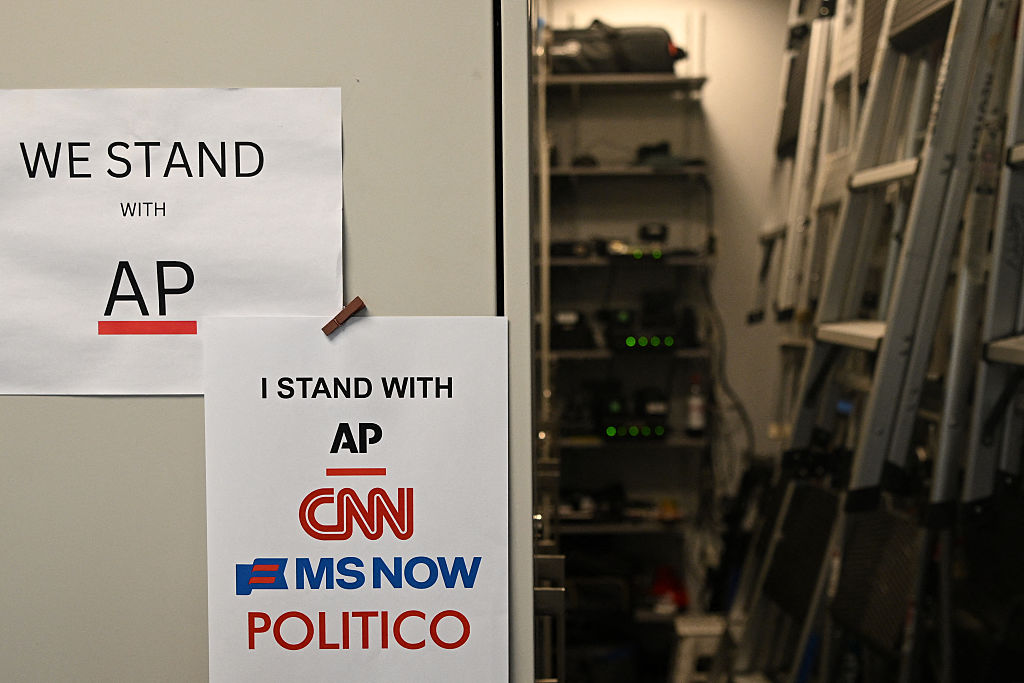
The Justice Department on Sept. 19 rescinded press access to journalists from CNN, MS NOW and Politico, with Trump forecasting the decision by vaguely blaming “cumulative stories over the last few years” and repeating denunciations of the outlets as “fake news.”
The backlash was swift. TV pool coverage was completely suspended for several days as other networks joined in solidarity with the banned outlets. The administration then launched “Trump TV,” an all-hours YouTube channel that some critics likened to state-run media.
By the time Trump elaborated in a Sept. 21 social media post, he said he wasn’t attacking the press but “instituting an assault on the FAKE NEWS, something that has grown like Cancer in our beloved United States of America.”
“It is a threat to our National Security, and must be stopped, NOW!” he wrote.
DOJ, in response to a lawsuit filed on the matter, similarly said the outlets had been “publishing sensitive or classified information,” according to the department’s court filing.
“What they were saying was that these media organizations had published stories that included sensitive national security information, often anonymous sources, and that that was justification for the ban,” Roberts said.
Coverage quickly resumed Friday after a federal judge ordered the Trump administration to reinstate access for the reporters, rejecting the national security argument.
Read:
7 Best Defense Stocks to Buy Now
Triumphal Arch
Trump last year announced plans to build a 250-foot tall triumphal arch memorial in Washington, D.C., as part of broader celebrations for America’s 250th anniversary. The plans were met with similar legal skepticism to the ballroom – a lack of approval from both Congress and the National Capital Planning Commission.
The arch drew a fair share of public criticism, with complaints about its size fundamentally altering the skyline and spoiling the views to and from the National Mall and Arlington National Cemetery. Legal battles ensued even as the regulatory process appeared poised to turn against the project.
Trump’s response? Similarly to the ballroom, he announced plans to militarize the memorial in a social media post last week. Trump wrote that the arch will “house, store, and have the rapid ability to use large numbers of drones, plus Snipers, on both the roof and plaza areas, and additionally have and hold large quantities of sniper ammunition in storage.”
While the abrupt militarization of the monument could allow it to sidestep some regulatory hurdles, it could also invite entirely new legal challenges. The arch’s previous appeal as a tourist attraction also appears contradictory to the kind of military power Trump has described.
Rejecting AI Restrictions
When former Anthropic researcher Jacob Coxon announced earlier this month that he would be leaving the company over concerns that the technology could bring about human extinction by 2030, it was a watershed moment for the burgeoning field.
Industry leaders and stakeholders called for AI development to slow following the announcement, pointing to several cases of chatbots hacking into other models and stealing information. The high-profile warnings sparked calls for regulation, a bid to ensure control of the technology before it grew too vast to handle.
Read more Fed Watchdog Flags Apparent Data Breaches by Retiring Staff Member
Trump rejected those calls, saying talk of an existential threat was a “hoax” and a “sick conspiracy” and that a slowdown could allow rival countries like China to outpace the U.S.
Trump’s expressed concerns about AI differed slightly from his other invocations of national security, largely because Trump has expressed them before, repeatedly countering attempts to curb AI in the interest of staying ahead and framing the issue as one of national security.
The president in December signed an executive order blocking state restrictions on AI, based in part on the need for AI capabilities to be coordinated across federal agencies due to national security considerations – though that hasn’t stopped some states.
And the first page of Trump’s AI Action Plan, released in July, features this quote from the president:
“As our global competitors race to exploit these technologies, it is a national security imperative for the United States to achieve and maintain unquestioned and unchallenged global technological dominance.”
But – not dissimilar to his national security pronouncements about the ballroom, the arch or the media – the president was facing public outcry and broad opposition to his position when he raised the specter of China. As recently as Tuesday, he resisted the suggestion that the two countries should work together, saying that China would “be able to immediately gain access to things that we know that they don’t know.”
Or as he said more succinctly on social media, “WHOEVER WINS AI, WINS!”
Subpoenaing Journalists
The recent pattern of invoking national security has precedent earlier in the administration – well before the pattern of bypassing regulation or opposition.
The Justice Department in July issued subpoenas seeking testimony and phone records from three New York Times journalists and their families following reporting on security issues with the Qatari-gifted Air Force One aircraft.
The tactic was met with outcry from press freedom advocates, who saw it as an attempt at intimidation. Administration officials in response claimed the subpoenas were necessary to prevent the leaking of government secrets.
The department withdrew the subpoenas after a federal judge severely criticized the move during a hearing. No attempt has since been made to reissue them.
“Make no mistake, this investigation remains ongoing, and we will pursue justice against those threatening national security by leaking classified information, a serious federal crime,” the department wrote in a statement following the withdrawal.
Goodman said one of the Trump administration’s potential motives in invoking national security so constantly is to stifle resistance.
“I think the administration’s intention is to chill dissent and opposition, and to make it seem like dissent and opposition are threats to national security,” Goodman said.
Pausing Wind Farm Construction and Boosting Fossil Fuels
Trump’s many executive orders on his first day in office included a directive to halt offshore wind lease sales.
The move was hardly surprising. Trump has long held some dubious opinions about wind turbines.
“I know more about wind than you do,” Trump said in his 2020 presidential debate against Joe Biden. “It’s extremely expensive, kills all the birds. It’s very intermittent – got a lot of problems.”
Soon after Trump’s executive order, the Interior Department halted construction on five large wind farms off the East Coast. The Department of Defense similarly stopped issuing permits in Texas earlier this summer, affecting 54 projects. But this time they had a new justification.
The common thread? The Interior Department in its directive letter pointed to “the rapid evolution of relevant adversary technologies and the resulting direct impacts to national security from offshore wind projects.”
Trump also invoked war powers to boost federal funding for fossil fuel projects. In April, the president signed a series of determinations under the Defense Production Act of 1950, allowing him heightened control over domestic sectors and the ability to use billions of defense dollars set aside under the bill.
The executive action built on a “national energy emergency” Trump declared upon entering office. Biden previously invoked the same powers to boost clean energy production.
Stripping Union Rights
Soon after assuming office, Trump signed a pair of executive orders aimed at exempting federal agencies “with national security missions” from labor laws that allow government workers to bargain collectively. Government Executive reported that these orders affected roughly two-thirds of the federal workforce.
The Trump administration accused “hostile federal unions” of obstructing national security actions and attempting to block Trump’s agenda. Notably, law enforcement officers and firefighters were not included in the order. Multiple lawsuits between federal unions and the Trump administration remain active.
Roberts said the various arguments could weaken future presidents’ ability to invoke national security as effectively.
“I think that the more absurd you get, the more skeptical judges are going to be,” Roberts said. “That then erodes the presumption of regularity around national security justifications, and so that would then make it more difficult for future administrations to have judges just believe what they say about national security.”
Read more Florida Asks Court to Bar OpenAI From Developing New Models as Part of Child Harm Lawsuit