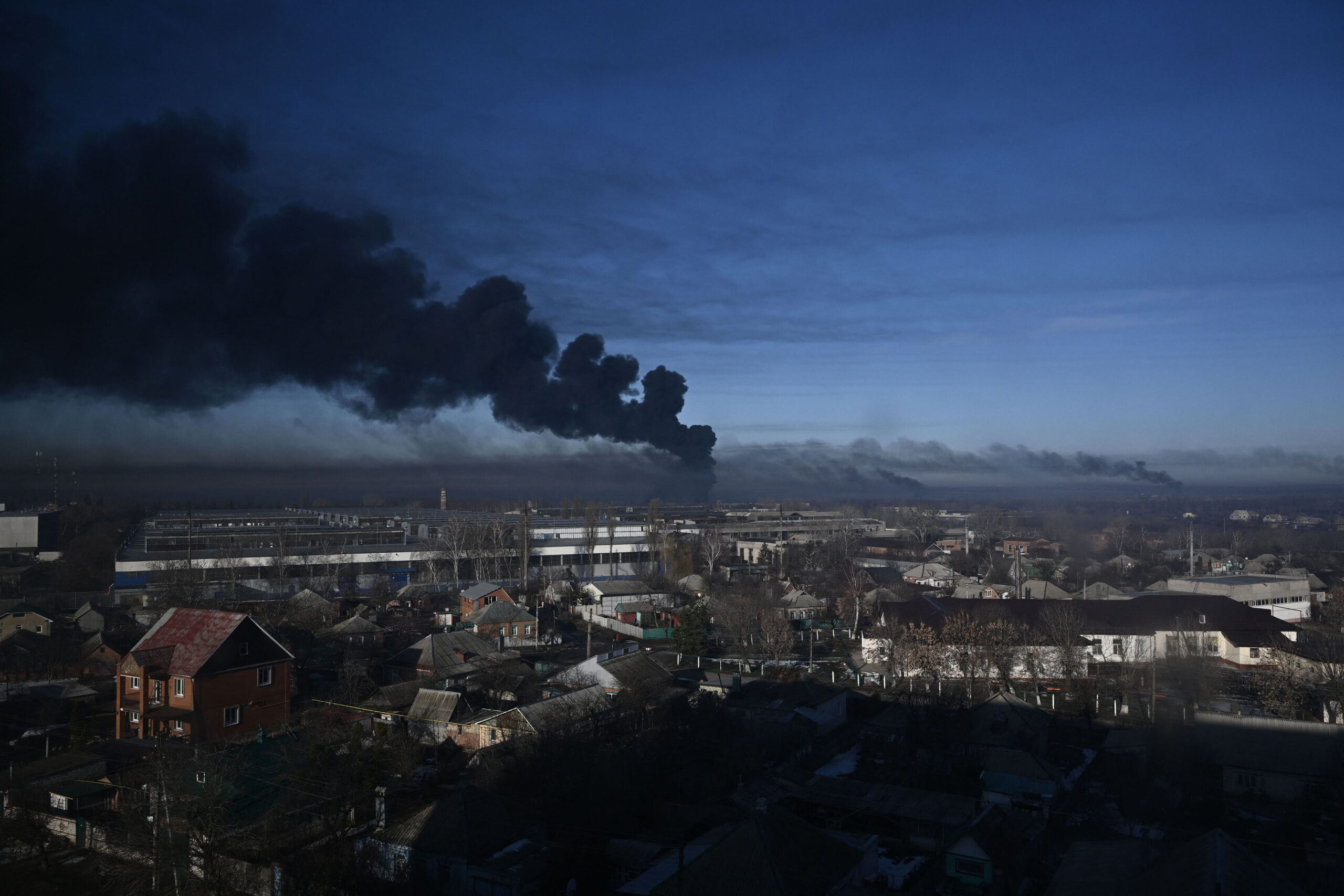





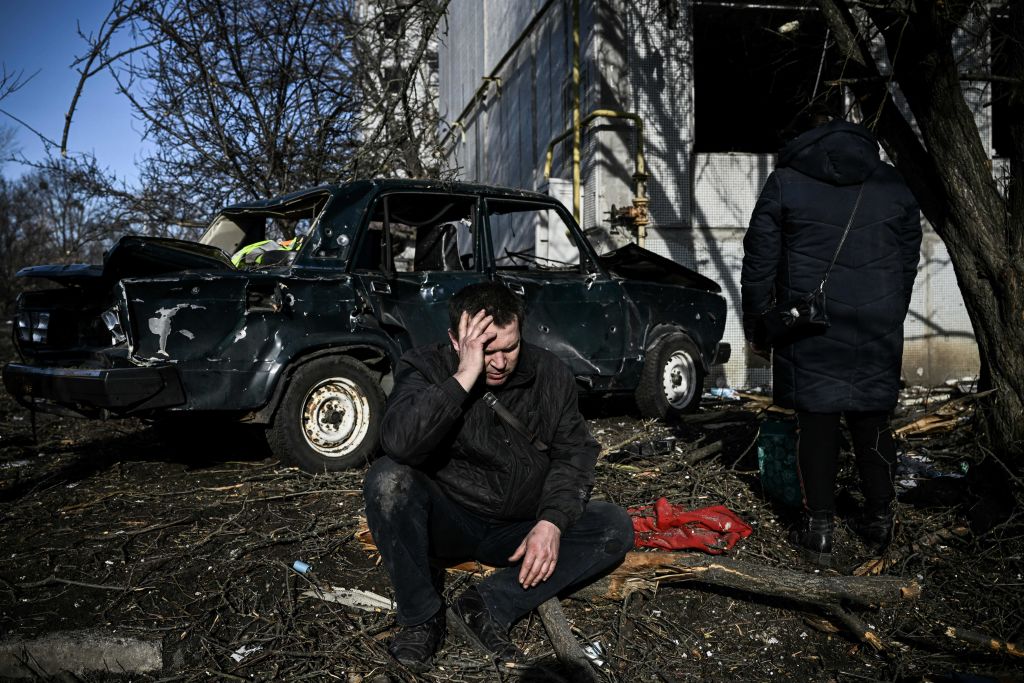
Widely held predictions of a full-scale Russian invasion of Ukraine came true in the early morning hours of Feb. 24, 2022. What fewer predicted was that three years later the fight would still be raging.
Read more What to Know About Ukraine’s Critical Minerals, and Why Trump Has His Eye on Them
The long-simmering tensions between the two countries grew when Russia amassed up to 190,000 troops – according to reports from the U.S. – on the neighboring borders of the former Soviet Union state starting in late 2021. Russian President Vladimir Putin later escalated matters by recognizing the Russian-backed breakaway regions of Donetsk and Luhansk, both located in the disputed Donbas area, as “independent” people’s republics and ordered so-called peacekeeping troops into those areas.
What started as a concerning situation with hopes for dialogue and diplomacy evolved into what the Ukrainian foreign minister described as the “most blatant act of aggression in Europe since” World War II. Tens of thousands on both sides have died since, with Russia taking control of some Ukrainian territory.
Analysts say the roots of the tension can be tied to some combination of the complicated history between the two countries, Russia’s ongoing tensions with NATO and the ambitions of one man: Putin.
What Is the History Between Ukraine and Russia?
Russia and Ukraine have what either side might describe as a common, if complicated, legacy that dates back a thousand years. In the last century, Ukraine, known as the breadbasket of Europe, was one of the most populous and powerful republics in the former USSR, as well as an agricultural engine of the Soviet Union until declaring independence in 1991, according to the Council on Foreign Relations. But Russia has kept a close eye on its neighbor to the west, while Ukrainians have found their independence to be tumultuous at times, with periods of protests and government corruption.
Ukraine’s ambitions to align itself more with Western countries – including its publicly stated interest in joining NATO, which itself was founded at least in part to deter Soviet expansion – has been met with aggression from Russia, the council notes. While not a member of the alliance, the U.S. and the U.K. agreed – along with Russia – to provide Ukraine with certain security assurances in 1994 as part of the process by which the country handed over control of a nuclear arsenal that had been the third-largest in the world.
Tensions came to a head in 2014 after Ukrainians ousted a Russia-aligned president. Russia – under the dubious claim of protecting ethnic Russians and Russian-speakers from Ukrainian persecution – annexed the Crimea region of Ukraine in a move widely condemned by the international community.
EXPLAINER:
What Is Article 5 and How Does it Shape NATO’s Ukraine Response?
At about the same time, Russia fomented dissension in the Donbas area of eastern Ukraine, backing a separatist movement in the regions of Donetsk and Luhansk that resulted in armed conflict. The regions declared independence as both sides dug in for a protracted standoff. The conflict between the two countries persisted, with at least 14,000 people dying between 2014 and 2021, according to the council.
When Did the Current Conflict Between Russia and Ukraine Begin?
Russia started growing its military presence around Ukraine – including in Belarus, a close Russia ally to the north of Ukraine – in late 2021 under various pretenses while remaining vague on its intentions. By December of that year, tens of thousands of Russian troops were hovering on the border, virtually surrounding the country and stoking tensions that led to a call between Putin and former President Joe Biden.
Fears escalated in early 2022 as the number of Russian forces surrounding Ukraine increased. Biden and Putin talked again, U.N. Security Council sessions were called to address the crisis, and numerous leaders from NATO, the U.S. and other countries called on Russia to de-escalate or face retaliation in some form. Russia still invaded.
What Does Russia Want When it Comes to Ukraine?
A principal demand of Russia is to prevent Ukraine from joining NATO, a military alliance between 30 European countries and two North American countries dedicated to preserving peace and security in the North Atlantic area. Ukraine is one of just a few countries in Eastern Europe that aren’t members of the alliance. The Kremlin in general views NATO expansion as a “fundamental concern.”
It’s noteworthy, however, that NATO likely had little intention of admitting Ukraine to the organization leading up to the invasion, William Pomeranz, a senior fellow and the former director of the Kennan Institute at the Wilson Center, a non-partisan policy forum for global issues, told U.S. News at the time.
Putin, specifically, does not want Ukraine to join NATO “not because he has some principled disagreement related to the rule of law or something, it’s because he has a might-makes-right model,” adds Bradley Bowman, the senior director of the Center on Military and Political Power at the Foundation for Defense of Democracies, a nonpartisan research institute focused on national security and foreign policy.
“He believes, ‘Hey, Ukraine, I’m more powerful than you, and because I’m more powerful than you, Ukraine, I can tell you what to do and with whom to associate,’” Bowman says.
Beyond the concern around NATO and other demands related to weapons and transparency, Russia’s nature of expansion is also at play when it comes to Ukraine. Some Russians, Putin included, remain aggrieved by the collapse of the USSR, and feel Russia has a claim to the former Soviet republic.
“The imperialistic policy of the Russian Federation requires from us and all the allies complex activities and complex deterrence and defense,” former Defense Secretary Lloyd Austin said during a Feb. 18, 2022, news conference.
What Does Putin Want Out of Ukraine?
The demands of the Russian government are inseparable from those of its authoritarian leader. Analysts note his broad ambitions, particularly those tied to his nostalgia for the territorial integrity of the USSR, that have been made clear by his actions.
“We know that Putin views the collapse of the Soviet Union as a disaster,” Bowman says. “We know he resents the success of NATO. We know that he genuinely reviles the expansion of NATO eastward. We know that he has an eye on history, he’s getting older, he is mindful of how he’s going to look in history books, and he sees himself as kind of a neo-czar who would like to reconstitute as much of the Soviet Union as possible.”
Ukraine, in particular, is a “critical element” of this ambition, Bowman adds. Putin has a history of invading and occupying countries that approach NATO membership. Russian armies invaded the former Soviet state of Georgia in 2008 as that country was pursuing membership in the alliance. They briefly pressured the capital Tbilisi before withdrawing to separatist regions they still occupy today. The 2014 Crimea annexation is another example, Bowman notes, and Putin said on Feb. 22, 2022, that he wants the world to recognize that territory as rightfully Russian. He rationalized in a 2021 essay that a common history and culture – which Ukrainians dispute – entitled Russia to exert its influence there.
“I think Ukraine has always been a sore spot for Vladimir Putin,” Pomeranz said.
The Russian president, however, might not have predicted the type of strong response from the international community he saw to the buildup on the Ukraine border. Bowman says because of this, Putin “is the most persuasive billboard possible for the value of NATO membership.”
Why Did Russia Invade Ukraine When it Did?
It all could have come down to Russia’s resources at that moment, Pomeranz said at the time. It might have been the “most opportune time” from Putin’s perspective, he added, because the country had $600 billion in foreign currency reserves and had already put significant resources into reconstructing Russia’s army.
Putin likely also viewed the West – including the U.S., specifically – as weak, Pomeranz added, which could have impacted how much help he thought Ukraine would actually get. Bowman echoes this sentiment and points to how the U.S. handled pulling troops out of Afghanistan in August 2021.
Read more Countries That Have Committed the Most Aid to Ukraine
“I don’t know how he could have read that as anything other than American weakness,” says Bowman, who served as an adviser to Republican senators for years.
Other reasons for action at the time could have been at play for Putin. A combination of factors – from the impact of the COVID-19 pandemic to Ukrainian President Volodymyr Zelenskyy’s lack of political experience – led to somewhat of a “perfect storm” for the Russian leader to act when he did, says Kimberly St. Julian-Varnon, a presidential doctoral fellow at the University of Pennsylvania.
“I think it’s his magnum opus,” she says. “I think this is his crowning achievement of whatever Putinism is.”
How Have the U.S. and Other Countries Responded to Russia’s Invasion?
The response was swift at the outset. The North Atlantic Council, the political decision-making arm of NATO, held an emergency meeting on Feb. 24, 2022, and activated its defense plans, which include the NATO Response Force. Biden had said before Russia’s attack that he would be sending more U.S. troops to Eastern Europe to defend NATO allies such as Poland but repeatedly stated he would not send U.S. troops into Ukraine.
Some countries had already responded to Putin’s actions related to the Donbas, which the U.S. called the “beginning of an invasion.”
Biden on Feb. 22, 2022, announced a series of sanctions against Russian financial institutions and the country’s elites. That followed an executive order he issued prohibiting new investment, trade and financing by U.S. persons to, from or in Donetsk and Luhansk. Former U.K. Prime Minister Boris Johnson announced his own country’s sanctions that day, targeted against Russian banks and billionaires, the BBC reported.
Biden promised in a statement the day after the invasion began that he would announce “further consequences the United States and our Allies and partners will impose on Russia for this needless act of aggression against Ukraine and global peace and security.”
That promise was kept. Since the war began, the U.S. has imposed thousands of different sanctions on Russia, according to a tally kept by the Atlantic Council that was last updated in November 2024.
Punishments have focused on, for example, Russian oil and gas imports and Russian banks. Many countries, such as Canada, the U.K. and others in Europe, have followed suit. The European Union has also imposed its own sanctions, targeting Russian individuals – including Putin himself – and energy. Countries have also committed about $430 billion in aid to Ukraine collectively, as of Dec. 31, 2024.
Three years in, the sanctions have inflicted some financial pain on Russia but haven’t done much to hinder economic growth. The International Monetary Fund in January 2025 estimated that Russia’s real gross domestic product grew 3.8% in 2024. The IMF’s growth projection for the country in 2025, however, was just 1.4%.
What Has Happened Since Russia Invaded Ukraine?
It’s hard to know where to begin, but one thing is clear – the war shows few signs of ending anytime soon.
As of January 2025, over 90,000 Russian soldiers – not including Ukrainian separatists – had died, while Ukraine had lost more than 65,000 of its own soldiers by mid-February. The total number dead or injured between the two countries reached 1 million in September 2024, according to The Wall Street Journal.
The losses don’t end there: The United Nations estimated that by the end of 2024, more than 12,300 civilians – including hundreds of children – had died in Ukraine since the invasion. Leaders and organizations around the world, such as the U.N. itself, have accused Russia of war crimes and other human rights atrocities.
While not overwhelmingly popular domestically, the war didn’t factor in Putin’s winning reelection to another six-year term as president in March 2024 – an unsurprising landslide that Western countries have decried as neither free nor fair. More significant for the Russian autocrat was that the election did not prove to be a catalyst for the type of massive anti-government protests that accompanied similar votes in 2012 and 2018.
And it’s generally agreed upon by onlookers that Ukraine has put up a much stronger fight in defending itself than many predicted.
Ukraine launched a surprising August offensive into Russia’s Kursk region near the border – reportedly the largest foreign attack on Russia since World War II – and took control of some Russian territory that analysts suggest they might plan to use to negotiate more favorable terms in the event of ceasefire talks. Russia, however, annexed four regions of Ukraine – Donetsk, Kherson, Luhansk and Zaporizhzhia – in September 2022, and has demanded control of all four areas, plus Crimea, if a ceasefire agreement is reached.
As of December 2024, the United States had committed more aid to Ukraine than any country, according to by the Kiel Institute for the World Economy. But collective aid between European countries and the European Union had surpassed total American support.
The conflict took a concerning new turn with word that 10,000 North Korean forces were in Russia as of mid-November, according to the U.S., Ukraine and South Korea.
Donald Trump’s victory in the November U.S. election added a layer of uncertainty to the situation. He had repeatedly criticized the scale of Western aid to Ukraine and promised a swift end to the war if he were in charge.
While the conflict did not end quickly upon Trump’s inauguration as he promised, American and Russian officials met in Saudi Arabia on Feb. 18, 2025, and agreed to start working toward ending the war. Ukrainian representatives, however, were not invited. Zelenskyy told reporters the meeting was a “surprise” to him, and that Ukraine wants “no one to decide anything behind our backs.” Secretary of State Marco Rubio said after the meeting there will be “engagement and consultation with Ukraine, with our partners in Europe and others,” but that the Russians in particular “will be indispensable to this effort.”
READ:
Fact-Checking Trump’s Claims About Zelenskyy
Trump’s return to the Oval Office has marked a shift in America’s posture toward the war in other ways as well. Earlier in February, the president said he wanted access to Ukraine’s rare earth minerals in exchange for further U.S. support, which was originally floated by Zelenskyy. Trump then lambasted Zelenskyy in a Feb. 19 post on social media that was riddled with falsehoods, saying the Ukrainian president has “done a terrible job” and describing him as a “Dictator without Elections.” Zelenskyy responded by saying Trump was living in a Russian-made “disinformation space.”